
A Better Way to Study Philippine Building Codes for the Architecture Licensure Exam
Architectural education is inherently visual. Architects learn through drawings, diagrams, and spatial interpretation. Scale is understood through sections, movement through plans, and relationships through spatial diagrams.
However, when architecture students begin preparing for the Architecture Licensure Exam (ALE) in the Philippines, this visual learning process often disappears.
Instead of diagrams and spatial reasoning, students are confronted with dense legal documents such as the National Building Code of the Philippines (PD 1096), the Accessibility Law (BP 344), the Fire Code of the Philippines (RA 9514), among many other regulatory frameworks. These laws are essential to safe and responsible architectural practice, yet they are frequently studied purely as text rather than as spatial systems.
For many architecture students preparing for the Architecture Licensure Exam, navigating these regulations can mean reviewing thousands of lines of legal provisions without the visual tools architects naturally rely on.
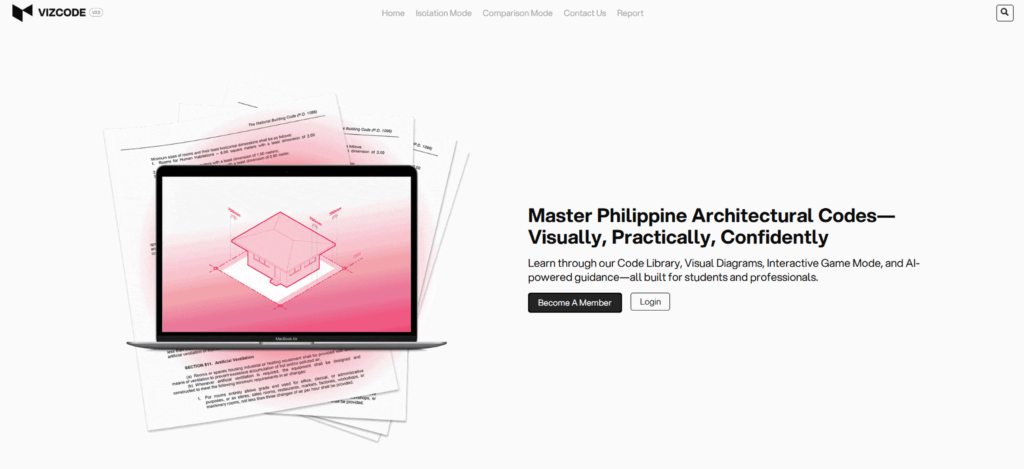
This long-standing challenge within architectural education in the Philippines became the foundation for VIZCODE, a digital platform designed to make Philippine building codes easier to understand, visualize, and apply.
Understanding Philippine Building Codes Through Visual Learning
Architectural regulations are not abstract legal concepts. They govern real physical space.
Every provision within the Philippine building codes influences how buildings are designed and constructed. These laws determine spatial conditions such as:
- Minimum clearances
- Room dimensions
- Accessibility requirements
- Fire safety provisions
- Environmental performance standards
For architects, these are fundamentally spatial problems rather than purely legal statements.
VIZCODE was developed around a simple premise: building codes should be studied the same way architects design — visually.
Instead of approaching the National Building Code of the Philippines and related regulations purely as written law, VIZCODE translates complex provisions into:
- Architectural diagrams
- Comparative regulatory frameworks
- Interactive Quizzes
By transforming legal text into visual architectural knowledge, the logic of each regulation becomes clearer and easier to retain.
A Unified Platform for Philippine Architectural Laws
One of the biggest challenges when studying for the Architecture Licensure Exam in the Philippines is fragmentation. Important regulations are distributed across multiple legal frameworks.
These include:
- National Building Code of the Philippines (PD 1096)
- Accessibility Law (BP 344)
- Fire Code of the Philippines (RA 9514)
- Subdivision and Condominium Buyers’ Protective Decree (PD 957)
- Economic and Socialized Housing Act (BP 220)
- Philippine Green Building Code
For architecture students and licensure examinees, navigating these separate legal systems can be overwhelming.
VIZCODE consolidates these key Philippine architectural laws into a structured visual framework focused on provisions that directly influence architectural planning and design.
The platform does not replace the original legal documents. Instead, it acts as a visual companion for studying Philippine building codes, helping architecture students understand how regulations operate within real architectural spaces.
A Smarter Architecture Licensure Exam Review System
Studying for the Architecture Licensure Exam (ALE) requires more than memorizing legal provisions. It requires understanding how those rules apply to real architectural problems.
VIZCODE was designed around how architects naturally process information.
The platform includes three learning environments:
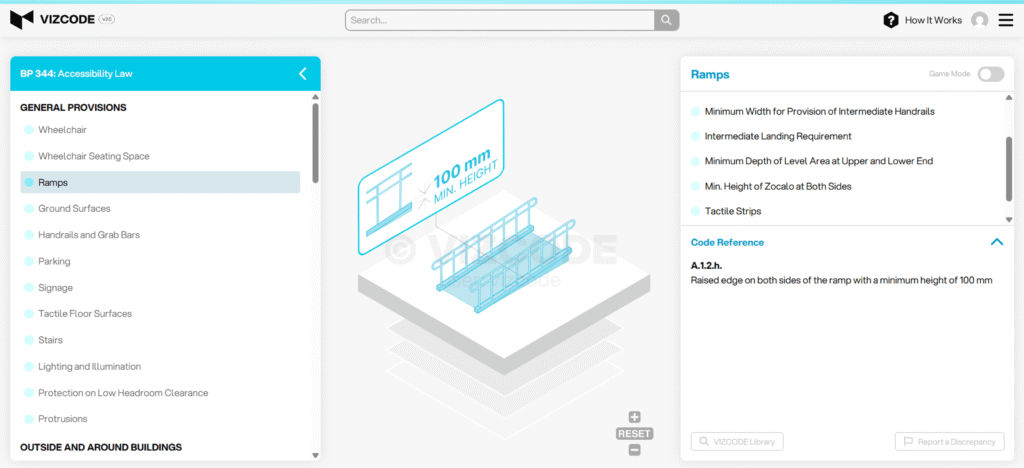
- Isolation Mode
Focused study of a specific Philippine building law or code provision, allowing learners to explore regulations in detail.
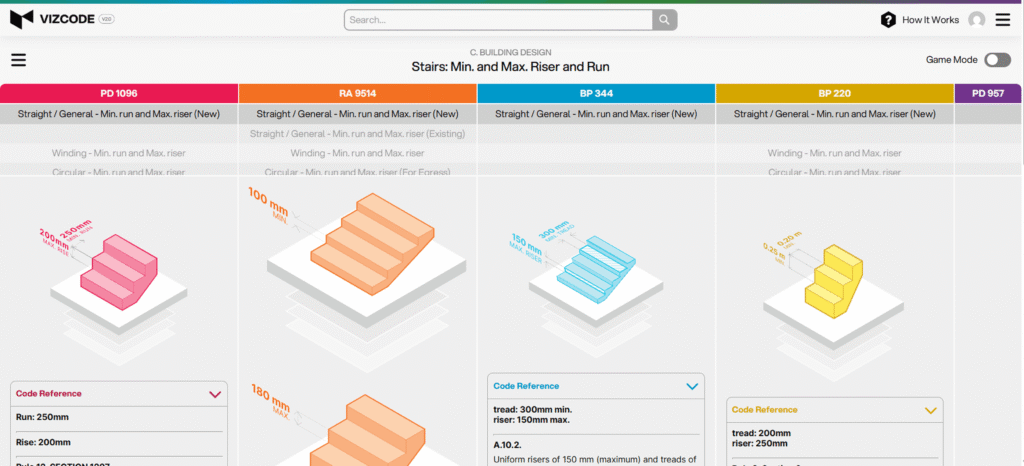
- Comparative Mode
Side-by-side analysis of overlapping regulations, helping architecture students understand how multiple Philippine building codes interact within a single design condition.
- Game Mode
Scenario-based challenges designed to reinforce recall and retention for Architecture Licensure Exam review.
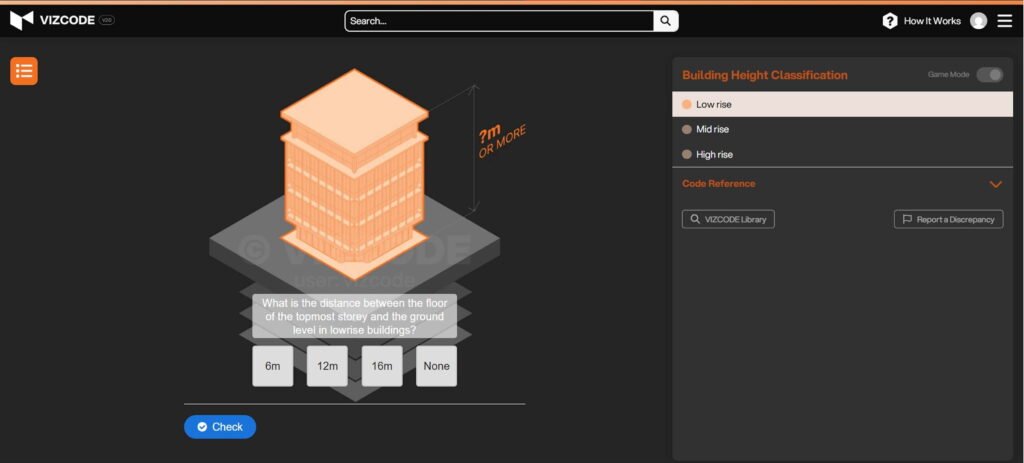
Gamification is not used simply for entertainment. Instead, it strengthens cognitive retention. Research consistently shows that active engagement improves memory far more effectively than passive reading, an advantage when preparing for the architecture board exam in the Philippines.
Learning Architectural Codes with AI: Meet QUBI
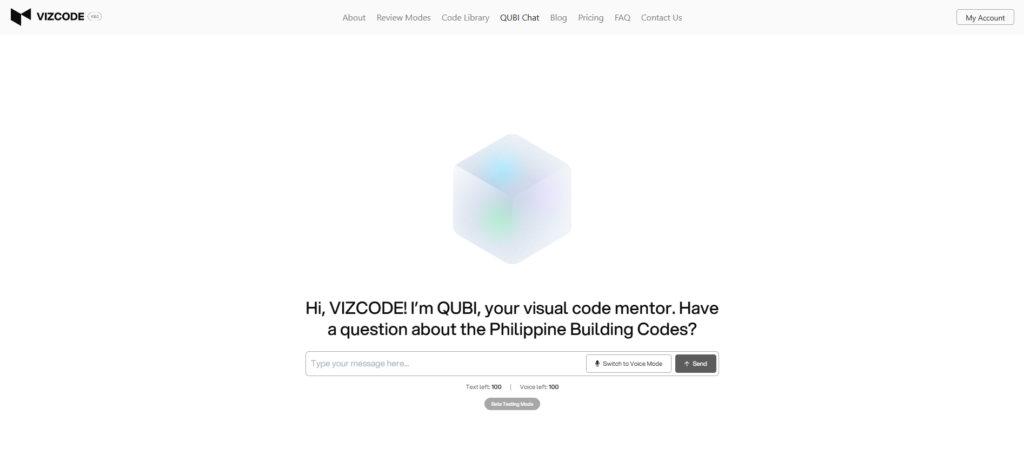
VIZCODE also integrates artificial intelligence through its in-platform mentor, QUBI.
QUBI helps architecture students understand difficult provisions within the Philippine building codes by:
- Explaining complex regulations in simplified language
- Answering questions related to the Architecture Licensure Exam
- Clarifying confusing architectural standards
- Providing contextual explanations for design scenarios
Rather than replacing traditional study methods, QUBI acts as an academic assistant for architecture students, helping unpack complex topics while encouraging deeper understanding of architectural regulations in the Philippines.
Beyond the Board Exam: Building Responsible Architects
Many review tools focus exclusively on helping students pass the Architecture Licensure Exam.
The deeper goal of VIZCODE, however, is professional competence.
A stronger understanding of Philippine building codes leads to:
- Safer buildings
- More inclusive accessibility design
- Better fire safety planning
- More environmentally responsible architecture
Regulatory literacy ultimately shapes the quality of the built environment. In professional architectural practice, these regulations directly influence how buildings protect people, communities, and cities.
Rethinking How Architects Learn Building Codes
VIZCODE does not attempt to simplify architectural laws by reducing their rigor.
Instead, it changes how they are learned.
By aligning building code education with visual cognition, spatial reasoning, and modern technology, VIZCODE transforms dense legal provisions into knowledge architects can actually apply.
Because mastering the Philippine building codes is not separate from architectural design.
It is an essential part of becoming a responsible architect.

Founder’s Note
VIZCODE was founded by Ar. Bernard B. Berberabe, principal architect of BEECUBEE Design. The platform was developed from his experience navigating architectural codes both as a licensure examinee and as a practicing architect in the Philippines.
Driven by curiosity and a relentless passion for learning, refining, and creating, his work reflects a commitment to timeless innovation – blending research, process, and design to craft spaces that inspire. Through VIZCODE, he channels this dedication into empowering future architects, simplifying complex architectural codes into an accessible platform born from his vision to transform challenges into opportunities for growth.